PM Narendra Modi “Mann Ki Baat” – 26 April 2026 (133rd Episode)
26/April/2026 13:47
Share:
PM Narendra Modi “Mann Ki Baat” – 26 April 2026 (133rd Episode)
A Detailed Creative Blog by SHOKESH MEDIA & SHOKESH BUZZ
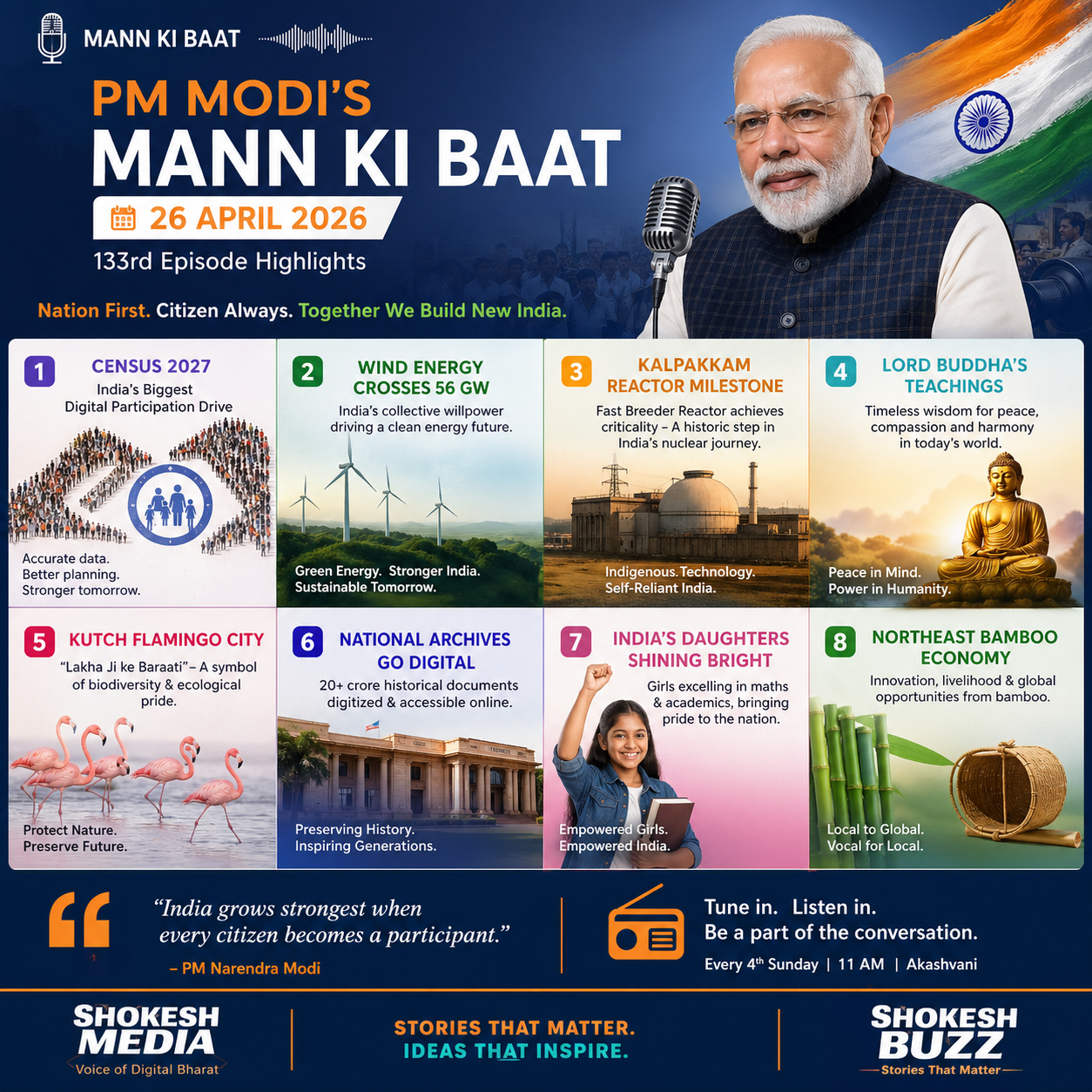
On 26 April 2026, Prime Minister Narendra Modi addressed the nation through the 133rd episode of Mann Ki Baat, his monthly radio programme that connects directly with citizens across India and abroad. Broadcast through Akashvani at 11 AM, this episode focused on national development, clean energy, biodiversity, heritage preservation, digital governance, scientific progress, and social participation.
Unlike a political speech, Mann Ki Baat remains a people-centric dialogue where the Prime Minister highlights ordinary citizens doing extraordinary work. This episode carried a strong message: India’s progress is not driven only by government policies, but by collective participation of every citizen.
---
Major Key Points Discussed in Mann Ki Baat – 26 April 2026
---
1. Census 2027 – India’s Biggest Digital Participation Drive
PM Modi called the upcoming Census 2027 one of the most important national campaigns and emphasized that this time the process is becoming more digital and people-friendly.
He urged citizens to actively participate and ensure correct data submission because census data helps shape future government planning in education, healthcare, housing, employment, and welfare schemes.
He described it as:
“This is one of the world’s biggest democratic participation campaigns.”
This reflects how governance is moving toward transparency and digital accessibility. Citizens are no longer passive beneficiaries—they are becoming active contributors to nation-building.
---
2. India’s Renewable Energy Revolution – Wind Power Crosses 56 GW
A major highlight was India’s achievement in renewable energy.
PM Modi proudly stated that India has crossed 56 Gigawatts of wind energy capacity, placing the nation among the top global leaders in wind power and ranking fourth globally in installed wind capacity. He called this a symbol of India’s collective willpower and engineering excellence.
This achievement is significant because:
It reduces dependence on fossil fuels
Strengthens energy security
Supports climate responsibility
Creates green jobs
Builds a sustainable future
He praised engineers, scientists, and workers behind this transformation.
This shows that India’s clean energy movement is no longer a dream—it is a visible reality.
---
3. Historic Nuclear Achievement – Kalpakkam Fast Breeder Reactor
PM Modi praised Indian nuclear scientists for the successful criticality achievement of the Fast Breeder Reactor at Kalpakkam, Tamil Nadu.
He explained that “criticality” means the reactor has successfully achieved a self-sustaining nuclear chain reaction for the first time—marking a major operational milestone.
This reactor is especially important because:
It is built using indigenous Indian technology
It supports energy production
It helps generate future nuclear fuel
It strengthens India’s scientific self-reliance
He called it a historic moment in India’s nuclear energy journey and appreciated the scientists who made Bharat proud.
---
4. Lord Buddha’s Teachings in Today’s World
In a world facing wars, tension, and conflict, PM Modi reflected on the timeless relevance of Bhagwan Buddha’s teachings.
He said that when the world is surrounded by unrest, Buddha’s message of peace, compassion, mindfulness, and harmony becomes even more powerful.
He also mentioned international efforts where organizations are spreading Buddha’s philosophy globally, including in South America.
This segment was deeply spiritual and philosophical, reminding listeners that development without peace cannot create true progress.
---
5. Biodiversity & Kutch Flamingo City
PM Modi beautifully spoke about the flamingos of Kutch and referred to them affectionately as “Lakha Ji ke Baraati.”
He highlighted the importance of bird conservation and India’s biodiversity protection.
This section celebrated:
ecological awareness
wildlife conservation
local pride
sustainable tourism
Such storytelling helps connect people emotionally with environmental protection rather than treating it as a distant policy issue.
---
6. National Archives of India – Preserving History Digitally
The Prime Minister highlighted a major heritage preservation initiative where over 20 crore historical documents have been digitized and made accessible through a dedicated portal by the National Archives of India.
This is a major step because:
India’s history becomes accessible to youth
researchers gain valuable archives
cultural memory is preserved digitally
national identity becomes stronger
This proves that modernization and heritage can move together.
---
7. India’s Daughters Making the Nation Proud
PM Modi also celebrated the achievements of India’s daughters, especially in mathematics and academic excellence.
He emphasized how girls across India are creating global recognition through talent and discipline.
This aligns with the larger vision of:
Beti Bachao, Beti Padhao → Beti Empowerment → Nation Building
This segment reflected confidence in India’s youth and women-led progress.
---
8. Northeast Bamboo Economy & Local Innovation
The Prime Minister highlighted how the bamboo sector in Northeast India is flourishing with innovation and value addition.
This creates:
rural employment
local entrepreneurship
export opportunities
sustainable development
This reinforces the “Vocal for Local” mission and shows how traditional sectors can become global opportunities.
---
SHOKESH MEDIA & SHOKESH BUZZ Opinion
Our Editorial Perspective
At SHOKESH MEDIA & SHOKESH BUZZ, we believe this episode of Mann Ki Baat was less about announcements and more about national mindset.
This episode reflected three powerful ideas:
1. Development Must Be Sustainable
From wind energy to nuclear science, India is clearly moving toward long-term self-reliance rather than short-term solutions.
2. Citizens Must Participate
Whether it is Census 2027, environmental protection, or preserving heritage—nation building requires public involvement.
3. India Needs Both Technology and Values
Clean energy and digital archives are important, but so are Buddha’s peace teachings and biodiversity awareness.
Modern India cannot grow only with machines—it must grow with wisdom.
---
Final Conclusion
The 133rd episode of Mann Ki Baat on 26 April 2026 showed how governance can become personal, emotional, and inspirational.
PM Modi did not simply discuss schemes—he connected science with society, development with culture, and progress with responsibility.
From nuclear reactors to flamingos, from digital census to Buddha’s philosophy, the message was clear:
“India grows strongest when every citizen becomes a participant.”
That is the real spirit of New India.
And that is what SHOKESH MEDIA proudly believes in.