Mahila Aarakshan Bill: A Historic Step Toward Women’s Political Empowerment in India
28/April/2026 18:26
Share:
Mahila Aarakshan Bill: A Historic Step Toward Women’s Political Empowerment in India
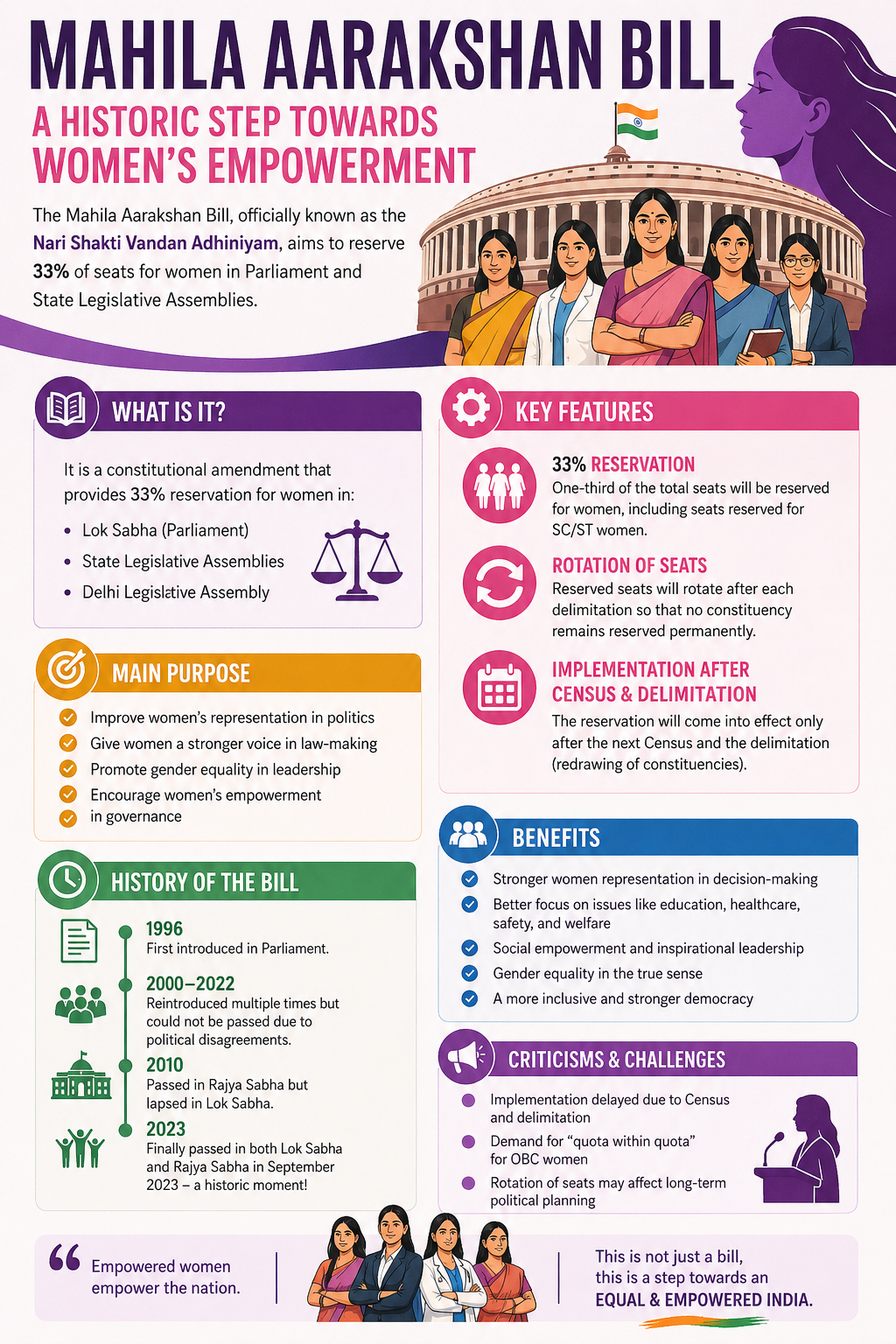
India, the world’s largest democracy, has made a historic move toward gender equality with the introduction and passage of the Mahila Aarakshan Bill, officially known as the Nari Shakti Vandan Adhiniyam. This landmark legislation aims to reserve 33% of seats for women in the Lok Sabha, State Legislative Assemblies, and the Delhi Legislative Assembly.
For decades, women in India have played a powerful role in society, business, education, and administration, yet their representation in politics remained comparatively low. The Mahila Aarakshan Bill seeks to change that reality by ensuring women receive equal opportunities in legislative decision-making.
This bill is not just about reservation—it is about representation, leadership, and the strengthening of Indian democracy.
---
What is the Mahila Aarakshan Bill?
The Mahila Aarakshan Bill is a constitutional amendment designed to provide one-third reservation (33%) for women in:
Lok Sabha (Lower House of Parliament)
State Legislative Assemblies
Delhi Legislative Assembly
This means that one out of every three seats in these bodies will be reserved exclusively for women candidates.
The bill also includes reservation for women belonging to Scheduled Castes (SC) and Scheduled Tribes (ST) within the already reserved seats for these communities.
This law is officially called the Nari Shakti Vandan Adhiniyam, symbolizing the respect and recognition of women’s strength and contribution to the nation.
---
Why Was This Bill Needed?
Despite India having women leaders like Indira Gandhi, Pratibha Patil, Sushma Swaraj, and many others, the overall participation of women in legislative politics has remained limited.
Current Representation Was Low
Women make up nearly 50% of India’s population, but their presence in Parliament and State Assemblies has historically been much lower.
For example:
Women MPs in Lok Sabha remained around 14–15%
Many State Assemblies had even lower representation
This imbalance created the need for structural reform.
Equal Participation in Democracy
Democracy becomes stronger when all sections of society are fairly represented. Women bring different experiences, priorities, and perspectives in policymaking—especially in areas like:
education
healthcare
child welfare
women safety
rural development
social justice
The bill ensures women have a stronger voice in national and state governance.
---
Key Features of the Mahila Aarakshan Bill
1. 33% Reservation for Women
The most important feature is the reservation of one-third seats for women in:
Parliament
State Assemblies
Delhi Assembly
This is one of the biggest constitutional reforms related to gender equality in Indian politics.
---
2. Reservation Within SC/ST Seats
Women belonging to Scheduled Castes and Scheduled Tribes will also get reservation within the seats already reserved for SC/ST communities.
This ensures inclusivity and broader representation.
---
3. Rotation of Reserved Seats
The reserved constituencies will not remain permanent.
They will rotate after each delimitation exercise, meaning different constituencies will be reserved in different election cycles.
This prevents political imbalance and gives wider opportunities.
---
4. Implementation After Census and Delimitation
The reservation will be implemented only after:
the next national Census
and delimitation of constituencies
This has become one of the most debated aspects of the bill because implementation may take time.
---
History of the Women’s Reservation Bill
The journey of this bill has been long and politically challenging.
First Introduced in 1996
The Women’s Reservation Bill was first introduced in Parliament in 1996 by the Deve Gowda government.
However, strong disagreements among political parties prevented its passage.
---
Reintroduced Multiple Times
The bill was reintroduced several times under different governments but failed to become law due to:
political opposition
demand for OBC reservation within women’s quota
disagreements over implementation methods
---
Rajya Sabha Passed It in 2010
The bill was passed in Rajya Sabha in 2010 during the UPA government, but it could not be passed in Lok Sabha and eventually lapsed.
---
Finally Passed in 2023
In September 2023, the bill was introduced again during the special session of Parliament and passed successfully by both Lok Sabha and Rajya Sabha with broad political support.
This marked a historic moment in Indian democracy.
---
Benefits of the Mahila Aarakshan Bill
1. Stronger Women Representation
Women will have greater participation in political decision-making at the highest levels.
---
2. Better Policy Focus
Issues affecting women, children, families, education, and healthcare may receive stronger legislative attention.
---
3. Social Empowerment
Political representation improves social confidence and inspires future generations of women leaders.
---
4. Gender Equality
The bill sends a strong national message that leadership is not limited by gender.
---
5. Democratic Strengthening
A truly representative democracy must include women equally.
This bill moves India closer to that goal.
---
Criticism and Challenges
While the bill is widely appreciated, some concerns remain.
Delay in Implementation
Because the reservation starts only after Census and delimitation, critics argue that the benefit is delayed instead of immediate.
---
Demand for OBC Women Reservation
Some political parties demanded a separate quota for OBC women, calling it “quota within quota.”
This issue continues to be debated.
---
Rotation Concerns
Frequent rotation of reserved seats may affect long-term political planning for candidates and parties.
---
Impact on Indian Politics
The Mahila Aarakshan Bill can reshape Indian politics in the coming decades.
It may lead to:
more women chief ministers
more women cabinet ministers
stronger grassroots leadership
better policy diversity
more inclusive governance
It can also inspire young girls across India to dream of political leadership.
---
Shokesh Media Opinion
At Shokesh Media, we believe the Mahila Aarakshan Bill is not just a legal reform—it is a social revolution.
Women have always been the backbone of Indian society. Giving them equal representation in law-making is not a privilege—it is justice.
This bill can become one of the most important democratic reforms of modern India if implemented effectively and fairly.
Real empowerment happens when women are not just voters, but decision-makers.
India’s future becomes stronger when women lead from the front.
---
Conclusion
The Mahila Aarakshan Bill stands as a powerful symbol of progress, equality, and democratic maturity.
After nearly 27 years of political struggle, India has taken a major step toward ensuring women receive the representation they deserve.
The true success of this bill will depend not only on its implementation but also on how society supports women leaders beyond politics.