Reliance Industries: The Complete Case Study of India’s Most Powerful Conglomerate
02/May/2026 17:47
Share:
? Introduction: More Than Just a Company
Reliance Industries Limited is not just India’s largest private company—it is a reflection of India’s economic evolution over the past six decades. From a small trading firm to a global business empire, Reliance has continuously adapted to changing markets, technologies, and consumer behavior.
What makes Reliance unique is its ability to transform itself at the right time. While most companies struggle to shift industries, Reliance has successfully moved from textiles to petrochemicals, from oil to telecom, and now toward digital platforms and green energy. This case study explores not just its journey, but also the strategy, risks, and future that define its dominance.
? Foundation & Early Vision (1958–1980s)
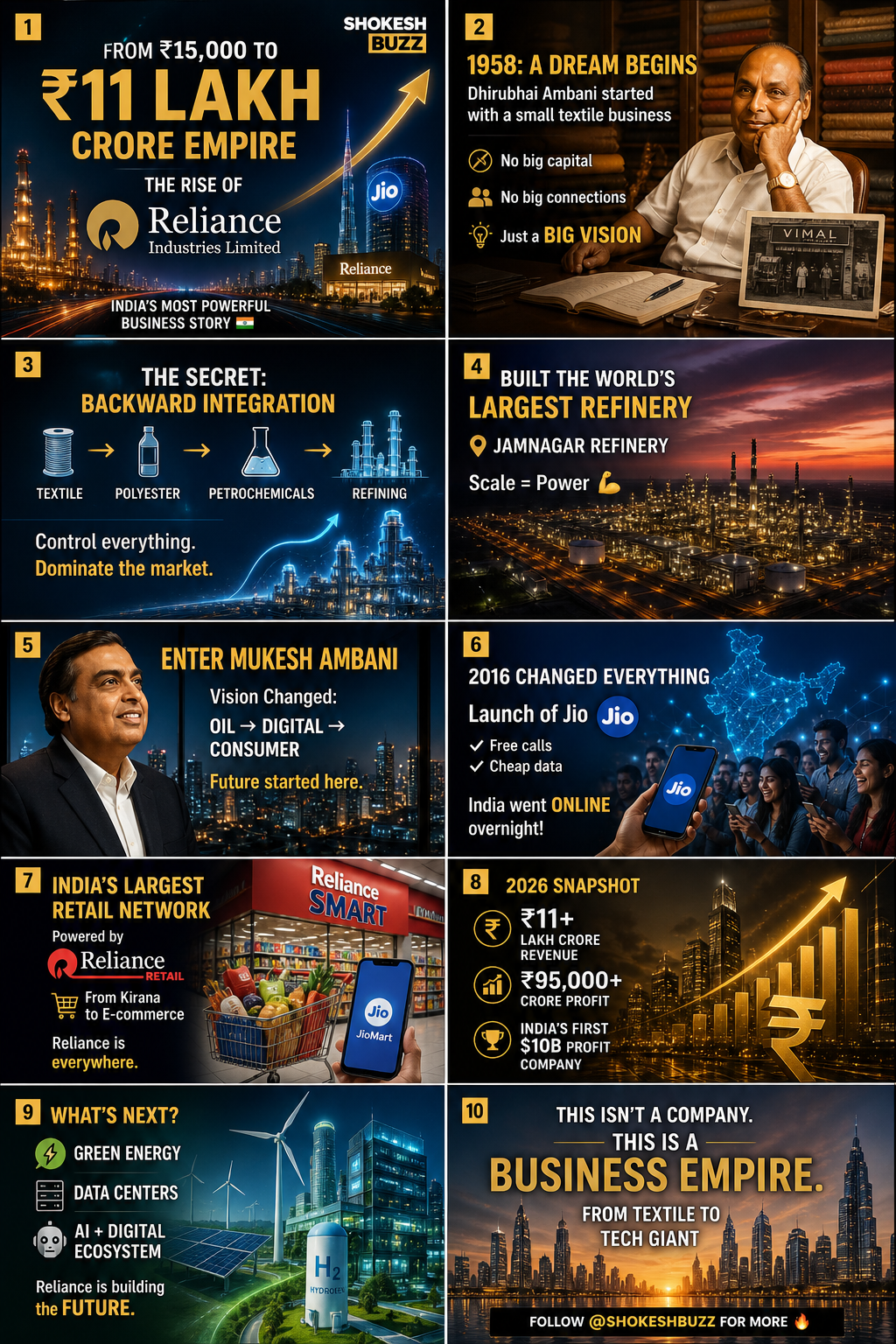
The story begins with Dhirubhai Ambani, a visionary entrepreneur who started Reliance in 1958 as a textile trading company. At a time when India’s economy was tightly regulated, Dhirubhai saw opportunity in scale, efficiency, and market demand.
He introduced branded fabrics under the “Vimal” label, which quickly became popular due to quality and affordability. But what truly differentiated him was his understanding of capital markets. He invited ordinary Indians to invest in Reliance, effectively democratizing equity investment in the country. This created not just a company, but a loyal investor base that trusted his long-term vision.
Dhirubhai’s approach was simple yet revolutionary: think big, execute fast, and never depend entirely on external suppliers. This mindset laid the foundation for Reliance’s future strategies.
? Backward Integration Strategy: Building Control & Scale
Reliance’s biggest early strategic move was its focus on backward integration. Instead of depending on suppliers for raw materials, the company began producing them internally. This led to expansion from textiles into polyester, then into petrochemicals, and eventually into refining.
This strategy culminated in the development of the Jamnagar Refinery, which is today the largest refining complex in the world. By controlling every stage of production, Reliance achieved significant cost advantages and operational efficiency.
Backward integration not only reduced dependency but also allowed the company to scale rapidly while maintaining quality. It became a defining feature of Reliance’s business model and a major reason behind its dominance in the energy sector.
⚡ Leadership Transition & Strategic Reinvention
After Dhirubhai’s passing in 2002, leadership transitioned to Mukesh Ambani, following a division of the family business. This period was crucial, as it required not just continuity but reinvention.
Mukesh Ambani recognized that the future would not be driven solely by oil and petrochemicals. He began reshaping Reliance into a diversified conglomerate with a strong focus on consumer-facing and technology-driven businesses.
Under his leadership, Reliance invested heavily in infrastructure, digital platforms, and retail networks. This marked a shift from a traditional industrial company to a modern, innovation-driven enterprise.
? The Jio Revolution: Transforming India Digitally (2016)
The launch of Reliance Jio in 2016 was perhaps the most disruptive move in Reliance’s history. At a time when mobile data in India was expensive and limited, Jio entered the market with free voice calls and extremely affordable data plans.
This strategy forced competitors to drastically lower prices, leading to consolidation in the telecom industry. More importantly, it made internet access accessible to millions of Indians, accelerating the country’s digital transformation.
Jio was never just a telecom service. It was designed as a digital ecosystem, integrating apps, content, payments, and connectivity. It became the foundation for Reliance’s expansion into digital services, positioning the company as a major technology player.
? Retail Expansion: Capturing India’s Consumption Story
Parallel to its digital growth, Reliance aggressively expanded its retail business through Reliance Retail. Today, it is the largest retailer in India, with a presence across grocery, fashion, electronics, and e-commerce.
The company adopted an omnichannel strategy, combining physical stores with digital platforms like JioMart. This allowed Reliance to cater to both urban and rural consumers while leveraging its telecom network for distribution and customer insights.
Reliance Retail’s growth reflects a deep understanding of India’s consumption patterns. By targeting both premium and mass markets, it has created a scalable and resilient business model that continues to grow rapidly.
? Business Model: Diversification as Strength
By 2026, Reliance operates through multiple business segments, including oil-to-chemicals, digital services, retail, oil and gas exploration, and new energy initiatives. This diversified structure ensures that the company is not overly dependent on any single sector.
The traditional oil-to-chemicals business continues to generate strong cash flows, which are then reinvested into high-growth areas like telecom, retail, and renewable energy. This internal funding mechanism reduces reliance on external financing and allows for long-term strategic investments.
Diversification also provides stability during market fluctuations. When one sector faces challenges, others compensate, ensuring consistent overall performance.
? Financial Performance: Scale Like No Other
Reliance’s financial growth has been remarkable. By 2026, the company has achieved record revenues exceeding ₹11 lakh crore and profits crossing ₹95,000 crore. It has also become the first Indian company to surpass $10 billion in annual profit.
A key trend in recent years is the increasing contribution of digital and retail businesses to overall profits. While the oil segment remains significant, its relative share is gradually declining as newer segments gain momentum.
This shift highlights the success of Reliance’s long-term strategy of moving from a commodity-based business to a consumer-driven and technology-led model.
? Transformation: From Oil Giant to Tech Powerhouse
Reliance’s transformation over the decades is nothing short of extraordinary. It has moved from being an oil and petrochemical company to a diversified conglomerate with strong presence in digital and consumer markets.
This transition reflects a broader global trend where traditional industries are being reshaped by technology. Reliance has managed to stay ahead of this curve by investing early and aggressively in future-oriented sectors.
The company’s ability to reinvent itself without losing its core strengths is what sets it apart from many other large conglomerates.
⚠️ Challenges & Risks
Despite its success, Reliance faces several challenges. The oil business remains vulnerable to global price fluctuations and geopolitical uncertainties. Retail operations, while growing, often face margin pressures due to intense competition and high operating costs.
Additionally, the company’s ambitious investments in new energy and digital infrastructure require significant capital and execution capabilities. Any delays or inefficiencies in these projects could impact future returns.
Competition is also intensifying across all segments, from telecom and retail to energy and technology. Global players and domestic rivals are constantly innovating, making the market more dynamic and competitive.
? Future Strategy: Betting on Tomorrow
Reliance’s future strategy is centered around sustainability, technology, and consumer growth. The company is investing heavily in renewable energy, including solar power, hydrogen fuel, and battery storage solutions.
In the digital space, it is expanding into cloud computing, artificial intelligence, and data centers, aiming to build a comprehensive digital ecosystem. Retail continues to evolve with a stronger focus on e-commerce and FMCG products.
These investments indicate a clear vision: to become not just India’s largest company, but a global leader in energy, technology, and consumer services.
? The Road Ahead
The next decade will be crucial for Reliance. Its success will depend on how effectively it can transition from its traditional energy base to new-age businesses. If executed well, this strategy could position Reliance as a global powerhouse across multiple industries.
However, the scale of its ambitions also brings complexity. Managing diverse businesses while maintaining efficiency and profitability will be a key challenge.
? Shokesh Buzz Final Verdict
Reliance Industries represents the power of vision, scale, and strategic transformation. It is not just a company that grew—it is a company that continuously evolved ahead of its time.
From textiles to telecom, from oil to digital platforms, and now toward green energy, Reliance’s journey is a masterclass in business strategy and execution.
? The real story of Reliance is not where it started,
? but how many times it successfully changed its future.
? Closing Thought
In today’s fast-changing world, Reliance teaches one powerful lesson:
“The biggest companies are not the ones that dominate today, but the ones that prepare for tomorrow.”