Special Intensive Revision (SIR) of Electoral Rolls: Everything You Need to Know About India’s Largest Voter Verification Drive
11/December/2025 22:11
Share:
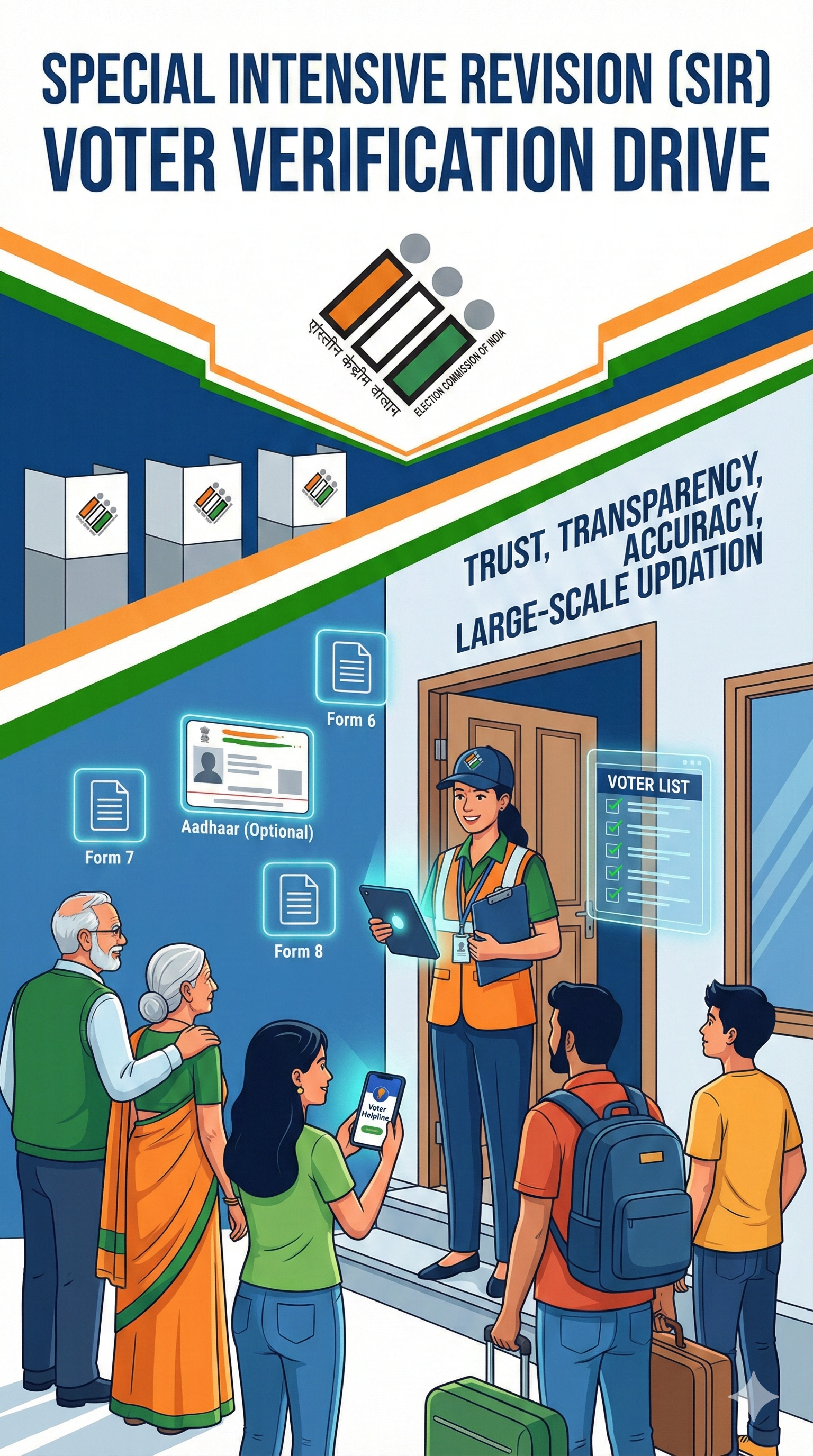
India, the world’s largest democracy, relies on accurate and transparent electoral rolls for free and fair elections. To maintain this integrity, the Election Commission of India (ECI) periodically conducts targeted verification campaigns. Among these, the Special Intensive Revision (SIR) stands out as one of the largest and most rigorous voter list verification drives undertaken across the nation.
The SIR is a systematic, door-to-door and digital verification process to ensure every eligible citizen is included in the electoral roll, and inaccuracies are corrected before major elections. Let’s explore what SIR is, why it matters, how it works, and what it means for citizens.
---
What is the Special Intensive Revision (SIR)?
Special Intensive Revision (SIR) is a comprehensive exercise conducted by the Election Commission to update, verify, and clean electoral rolls on a mass scale.
It goes beyond the routine annual revision and is launched when:
A large number of new voters are expected (e.g., before major elections)
There are discrepancies between population data and voter rolls
Massive migration or urbanization has created gaps
There is suspicion of duplicate or fraudulent entries
The state/UT requests a deeper verification drive
SIR ensures that the final voter list is error-free, inclusive, and transparent, fortifying the credibility of the election process.
---
Why is SIR Important?
1. Prevents Deletion of Genuine Voters
During elections, many citizens complain that their names are “missing” from the voter list.
SIR prevents such situations by performing:
House-to-house verification
Aadhaar seeding (voluntary)
Correction of spelling, address, and age details
Status verification of shifted, deceased, and duplicate voters
2. Helps Young Voters Get Enrolled
India sees millions of new 18+ citizens every year.
SIR prioritizes:
College students
First-time voters
Migrants living in rental or hostel accommodations
This ensures youth participation in democracy.
3. Enhances Transparency and Fair Elections
Clean and authentic electoral rolls reduce the chances of:
Booth capturing
Fake voting
Identity fraud
Multiple voter IDs
4. Supports Digital India
SIR integrates online systems:
Voter Portal (NVP)
Voter Helpline Mobile App
Form 6, 7, 8 online submission
Aadhaar authentication (optional)
This creates a modern, tech-driven electoral registration ecosystem.
---
How is SIR Conducted?
SIR is conducted in phases, combining field verification with digital updation.
1. Pre-Revision Activities
Mapping voters with new polling stations
Identifying areas with low enrollment
Training Booth Level Officers (BLOs)
Preparing draft voter lists
2. House-to-House Verification
BLOs visit every household to verify:
Existing voters
Newly eligible voters
Shifted or deceased cases
Incorrect data entries
Verification documents may include (not mandatory):
Aadhaar (voluntary)
Birth certificate
Rent agreement
Educational ID
Passport or driving licence
3. Disposal of Claims and Objections
Public can file:
Form 6 – New voter registration
Form 7 – Objection to entry/removal
Form 8 – Correction in voter details
These are scrutinized for authenticity.
4. BLO Camps and Special Booth Camps
These camps allow voters to:
Update details
Submit forms offline
Check their draft roll status
Verify polling station location
5. Integration with Digital Verification
Aadhaar-based authentication (optional)
EPIC-Aadhaar data linkage
Duplicate record detection software
GIS mapping for polling stations
6. Publication of Final Electoral Roll
After verification, public scrutiny, and corrections, the final updated roll is published online and offline.
---
Who Should Pay Special Attention During SIR?
SIR is especially important for:
First-time voters (18+)
People who shifted to a new house
College students living in hostels
Migrants working in metro cities
Senior citizens
NRI voters (if residing temporarily in India)
Women who changed address post-marriage
Failing to update details on time may lead to inability to vote.
---
My Opinion: Why SIR Matters More Today Than Ever
In my opinion, SIR is not just a bureaucratic exercise—it is the heartbeat of Indian democracy.
With fast urbanization, rising interstate migration, and millions of new young voters, maintaining an accurate voter list has become both challenging and crucial.
SIR serves as:
A safeguard against voter suppression, ensuring no eligible citizen is left out
A shield against electoral fraud, preventing ghost entries
A bridge between citizens and electoral institutions, building trust
A step towards digital democracy, making elections more efficient
However, citizens need greater awareness. Many people ignore BLO visits or fail to check their names online. The success of SIR depends not only on ECI but also on public participation.
Strengthening voter education during SIR campaigns can create a more informed and engaged electorate.
Conclusion
The Special Intensive Revision (SIR) by the Election Commission of India is a monumental, nationwide effort to ensure the accuracy, inclusivity, and fairness of the electoral process.
By updating entries, removing duplicates, and enrolling new voters, SIR strengthens the foundation of India’s democratic system.