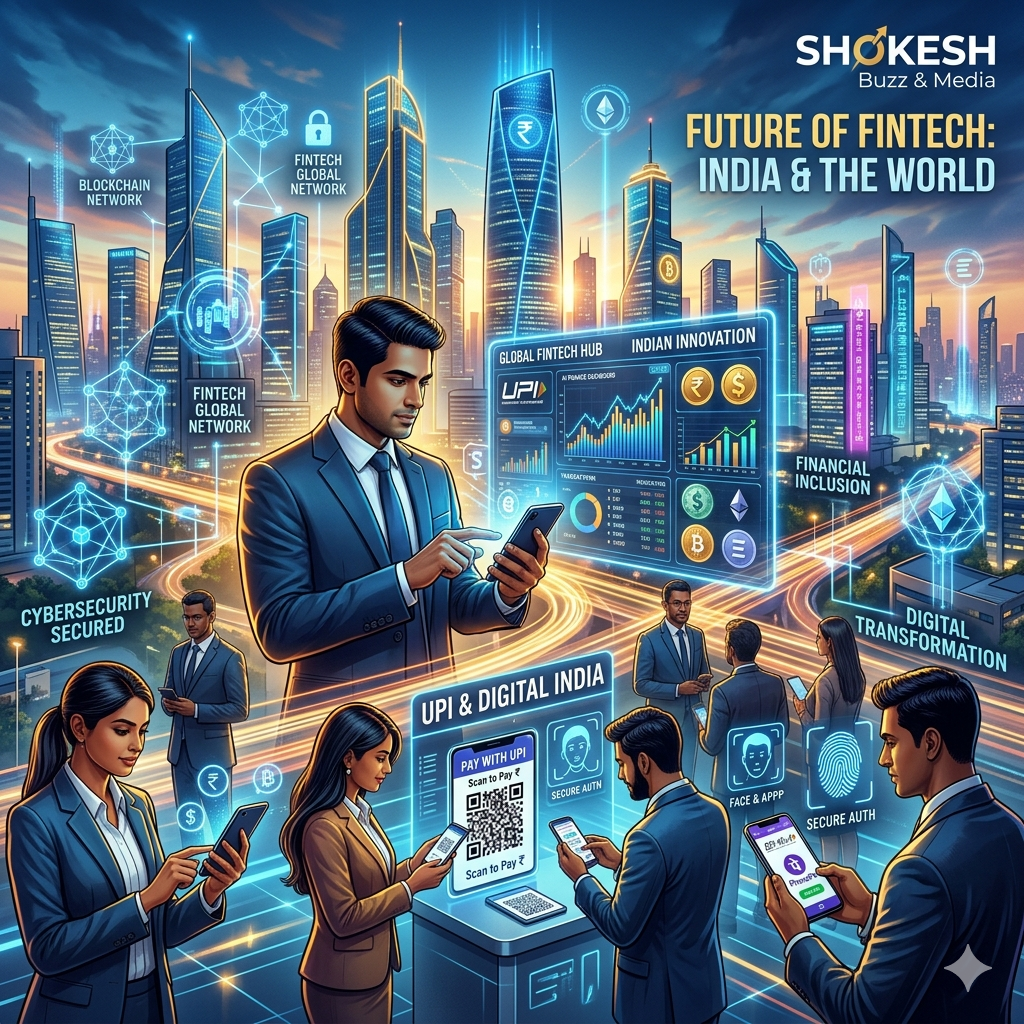
The Future of Fintech Companies: A Detailed Vision for SHOKESH Buzz & Media
27/April/2026 02:08
Share:
The Future of Fintech Companies: A Detailed Vision for SHOKESH Buzz & Media
In the rapidly evolving digital economy, financial technology—popularly known as fintech—has emerged as one of the most powerful forces reshaping global business and consumer behavior. From mobile payments and digital banking to blockchain-powered transactions and AI-driven lending systems, fintech companies are no longer just startups disrupting traditional banks—they are becoming the foundation of the future financial ecosystem.
For platforms like SHOKESH Buzz & Media, understanding the future of fintech is essential because this industry is not just transforming money—it is transforming trust, access, and the speed of economic growth.
According to Plaid, fintech app usage has risen significantly, with usage reaching nearly 78% and consumers increasingly expecting apps to act as financial co-pilots rather than simple payment tools. Meanwhile, JPMorgan Chase highlights that payments, tokenization, stablecoins, and B2B financial infrastructure are becoming the next major investment priorities for the sector in 2026.
This signals one clear truth: the future of fintech is not optional—it is inevitable.
---
What is Fintech?
Fintech refers to the use of technology to improve and automate financial services. It includes:
Digital payments
Online banking
Mobile wallets
Digital lending
Insurtech
Wealthtech
Cryptocurrency platforms
Buy Now Pay Later (BNPL)
Open banking
Embedded finance
AI-based financial advisory systems
Fintech companies bridge the gap between traditional finance and modern technology, making financial services faster, cheaper, and more accessible.
---
Why Fintech Companies Will Dominate the Future
1. The Rise of Cashless Economies
Countries like India have become global leaders in digital payments due to systems like UPI. Government-backed initiatives such as Digital India and real-time payment infrastructure have accelerated fintech adoption, with leaders publicly highlighting India’s strength in real-time digital transactions.
Consumers today prefer:
QR payments
Contactless transactions
Mobile wallets
Instant bank transfers
Subscription-based payment systems
Traditional cash transactions are rapidly declining, and fintech companies are becoming the backbone of daily commerce.
The future belongs to businesses that make payments invisible, instant, and intelligent.
---
2. AI Will Become the Brain of Fintech
Artificial Intelligence is no longer an experimental tool—it is becoming the operational engine of fintech.
AI is helping companies with:
Fraud detection
Credit risk analysis
Personalized financial advice
Automated customer service
Loan approval systems
Smart investment suggestions
Predictive financial planning
Plaid identifies AI shifting from novelty to consumer necessity and notes that fraud prevention is increasingly AI-led.
In the future, fintech apps will not simply show balances—they will guide users like personal financial advisors.
Your app may soon tell you:
“Your spending is high this month. Move ₹5,000 to savings.”
That is the next generation of fintech.
---
3. Open Banking Will Redefine Competition
Open banking allows financial institutions to securely share customer data with authorized third-party fintech platforms.
This creates:
Better loan offers
Faster approvals
Smarter financial planning
Better customer experiences
Greater competition among service providers
Open banking is becoming a baseline expectation rather than a luxury feature.
Banks will no longer own customers solely through branches—they will compete through APIs and user experience.
---
4. Embedded Finance Will Be Everywhere
Soon, people will access financial services without even visiting a bank app.
Examples:
Shopping apps offering instant EMI
Ride apps offering insurance
E-commerce platforms providing credit
Business software integrating payroll loans
This is called embedded finance.
Financial services will become invisible infrastructure inside everyday apps.
The future fintech company may not look like a bank—it may look like a shopping platform.
---
5. Blockchain and Stablecoins Will Expand
The next phase of fintech includes tokenization, blockchain settlement systems, and regulated stablecoins.
KPMG highlights stronger regulation and rising investor interest around digital assets and stablecoins in 2026.
This can improve:
Cross-border payments
International trade settlements
Transaction transparency
Cost efficiency
Financial security
The future is not just crypto speculation—it is regulated digital financial infrastructure.
---
6. Financial Inclusion Will Grow
One of fintech’s greatest contributions is financial inclusion.
Millions of people who were excluded from traditional banking can now access:
Micro-loans
Digital savings
Insurance
Investment platforms
Small business credit
Especially in rural and semi-urban India, fintech can create economic empowerment faster than traditional banking expansion.
This is not just innovation—it is social transformation.
---
Major Challenges Fintech Companies Must Solve
Cybersecurity
As digital finance grows, cybercrime grows faster.
Deepfake scams, AI-powered fraud, phishing attacks, and payment fraud are major risks. Cybersecurity is increasingly treated as the foundation of trust in fintech.
Trust is the real currency of fintech.
Without strong security, no innovation can survive.
---
Regulation and Compliance
Governments and central banks are increasing control over:
Lending systems
Digital payments
Crypto transactions
KYC and AML policies
Consumer data privacy
The fintech companies that survive will not be the fastest—they will be the most compliant and trustworthy.
---
Profitability vs Growth
Many fintech startups grow fast but struggle to make profits.
The future winners will be companies that balance:
User growth
Revenue stability
Customer trust
Regulatory compliance
Long-term sustainability
Growth without profit is temporary.
---
The Future of Fintech in India
India is positioned to become one of the world’s largest fintech markets because of:
UPI leadership
Aadhaar identity systems
Smartphone penetration
Youth-driven digital adoption
Government support
Startup ecosystem growth
A recent milestone was Pay Point India becoming the first private-sector fintech to join the RBI’s Centralised Payment System—previously limited mostly to banks and major institutions—showing how fintech is moving into core financial infrastructure.
The next decade may see India leading global innovation in digital finance.
---
SHOKESH Media Opinion
At SHOKESH Media, we believe fintech is not just the future of finance—it is the future of civilization’s economic movement.
The companies that will lead tomorrow are not those with the biggest offices, but those with the smartest digital infrastructure.
Fintech is changing how people:
earn
save
invest
borrow
insure
transact
build wealth
The real revolution is not digital payments.
The real revolution is financial empowerment.
For India, fintech is not merely a business opportunity—it is a national growth engine.
For young entrepreneurs, fintech is one of the greatest industries to build in.
For society, it is the bridge between economic inequality and financial freedom.
---
Final Conclusion
The future of fintech companies is bright, competitive, and transformative.
AI, embedded finance, open banking, blockchain, financial inclusion, and cybersecurity will define the next era.
Traditional banks will evolve.
New fintech giants will rise.
And consumers will demand speed, trust, and intelligence from every financial interaction.
The question is no longer:
“Will fintech shape the future?”
The real question is:
“Who will lead that future?”
And the answer may come from the next startup built today.