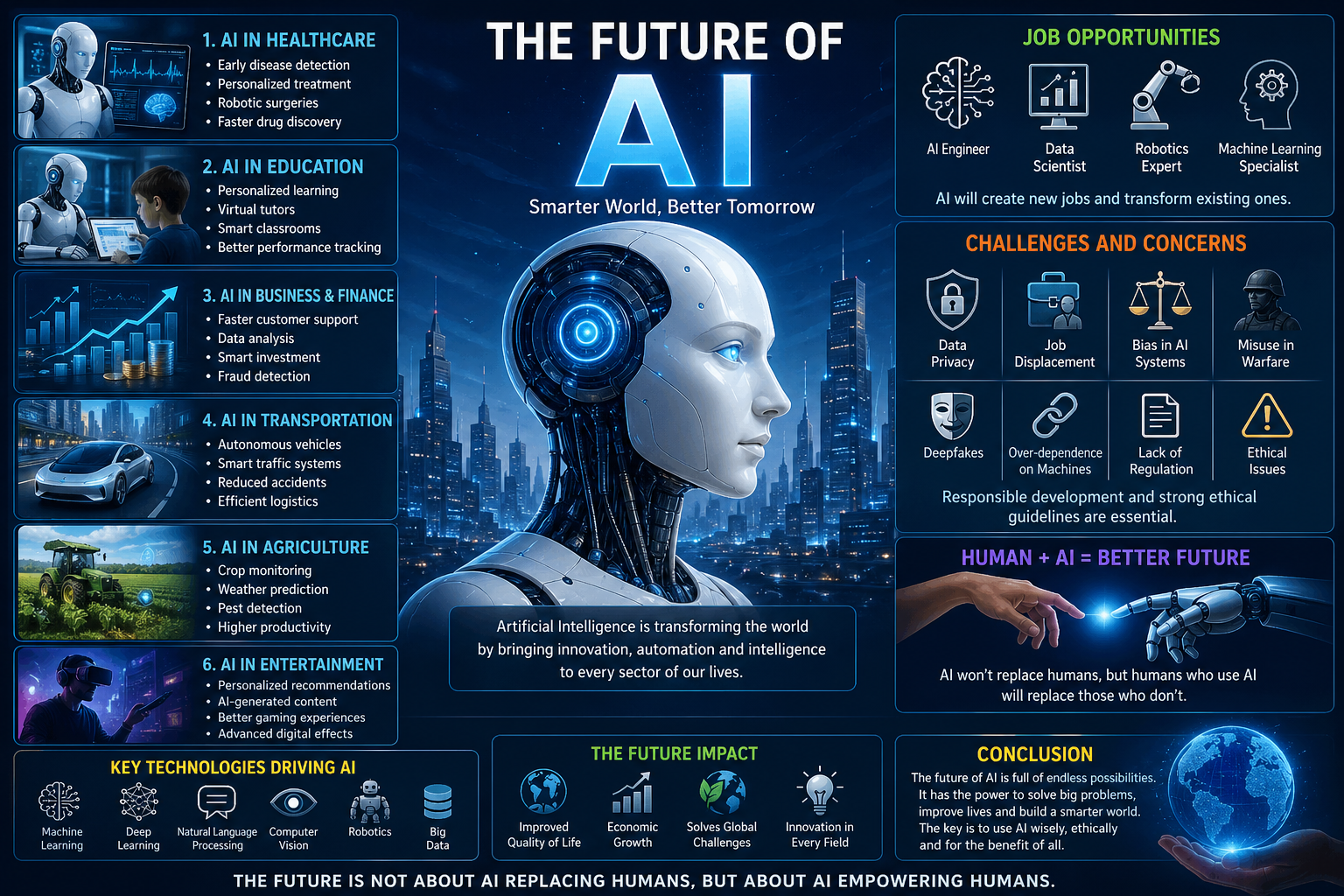
Artificial Intelligence (AI) is no longer just a concept from science fiction—it has become a powerful reality that is transforming industries, businesses, and daily life. From smartphones and smart homes to healthcare, education, and finance, AI is shaping the future faster than ever before. The future of AI holds immense possibilities, bringing both opportunities and challenges for humanity.
What is Artificial Intelligence?
Artificial Intelligence refers to machines and computer systems that can perform tasks that usually require human intelligence. These tasks include learning, problem-solving, decision-making, language understanding, and visual recognition. AI systems use data, algorithms, and computing power to improve their performance over time.
Examples of AI today include virtual assistants like Siri and Alexa, recommendation systems on YouTube and Netflix, self-driving cars, chatbots, and medical diagnosis systems.
---
The Future Scope of AI
The future of AI is expected to be much bigger and more impactful. Experts believe AI will become one of the most important technologies of the 21st century.
1. AI in Healthcare
AI will revolutionize healthcare by helping doctors diagnose diseases faster and more accurately. It can analyze medical reports, X-rays, and scans within seconds. AI-powered robots may assist in surgeries, while predictive systems can warn about diseases before symptoms appear.
Future benefits:
Early disease detection
Personalized treatment plans
Faster drug discovery
Better patient care
---
2. AI in Education
Education will become smarter and more personalized. AI can understand the learning speed of each student and provide customized lessons. Virtual tutors and AI teachers may become common in schools and colleges.
Future benefits:
Personalized learning
Smart classrooms
Better student performance tracking
Reduced educational gaps
---
3. AI in Business and Finance
Businesses are already using AI for customer service, fraud detection, and data analysis. In the future, AI will handle more complex decision-making, automate routine tasks, and improve financial planning.
Future benefits:
Faster customer support
Improved business decisions
Smart investment strategies
Fraud prevention
---
4. AI in Transportation
Self-driving vehicles are one of the biggest examples of AI's future. AI can reduce accidents, improve traffic management, and make transportation safer and more efficient.
Future benefits:
Autonomous cars
Smart traffic systems
Reduced accidents
Faster logistics and delivery
---
5. AI in Agriculture
Farmers can use AI to monitor crops, predict weather, detect pests, and improve production. This will increase food security and reduce waste.
Future benefits:
Smart farming
Better crop management
Water conservation
Higher agricultural productivity
---
6. AI in Entertainment and Media
AI will continue to transform content creation, music, films, and gaming. It can help create personalized entertainment experiences and improve audience engagement.
Future benefits:
AI-generated content
Personalized recommendations
Better gaming experiences
Advanced digital marketing
---
Job Opportunities and Challenges
AI will create many new jobs such as AI engineers, data scientists, robotics experts, and machine learning specialists. However, it may also replace repetitive and manual jobs.
This creates a major challenge: people must upgrade their skills to stay relevant in the changing job market.
Important future skills:
Digital literacy
Programming knowledge
Critical thinking
Creativity
Human communication skills
---
Ethical Concerns of AI
While AI offers great benefits, it also raises serious concerns.
Main concerns include:
Data privacy issues
Job displacement
Bias in AI systems
Misuse of AI in warfare
Deepfake technology
Over-dependence on machines
Governments and organizations must create strong rules and ethical guidelines to ensure AI is used responsibly.
---
Will AI Replace Humans?
AI can replace certain tasks, but it cannot fully replace human emotions, creativity, ethics, and empathy. The future is not about AI replacing humans—it is about humans working together with AI.
The best future will be where AI acts as a helper, not a controller.
---
Conclusion
The future of AI is bright, powerful, and full of possibilities. It has the potential to solve some of the world's biggest problems, from healthcare and education to climate change and poverty. However, with great power comes great responsibility.
The success of AI depends not only on technology but also on how humans choose to use it. If guided wisely, AI can become one of humanity’s greatest achievements.
AI is not just the future—it is the present, and its future will define our future.